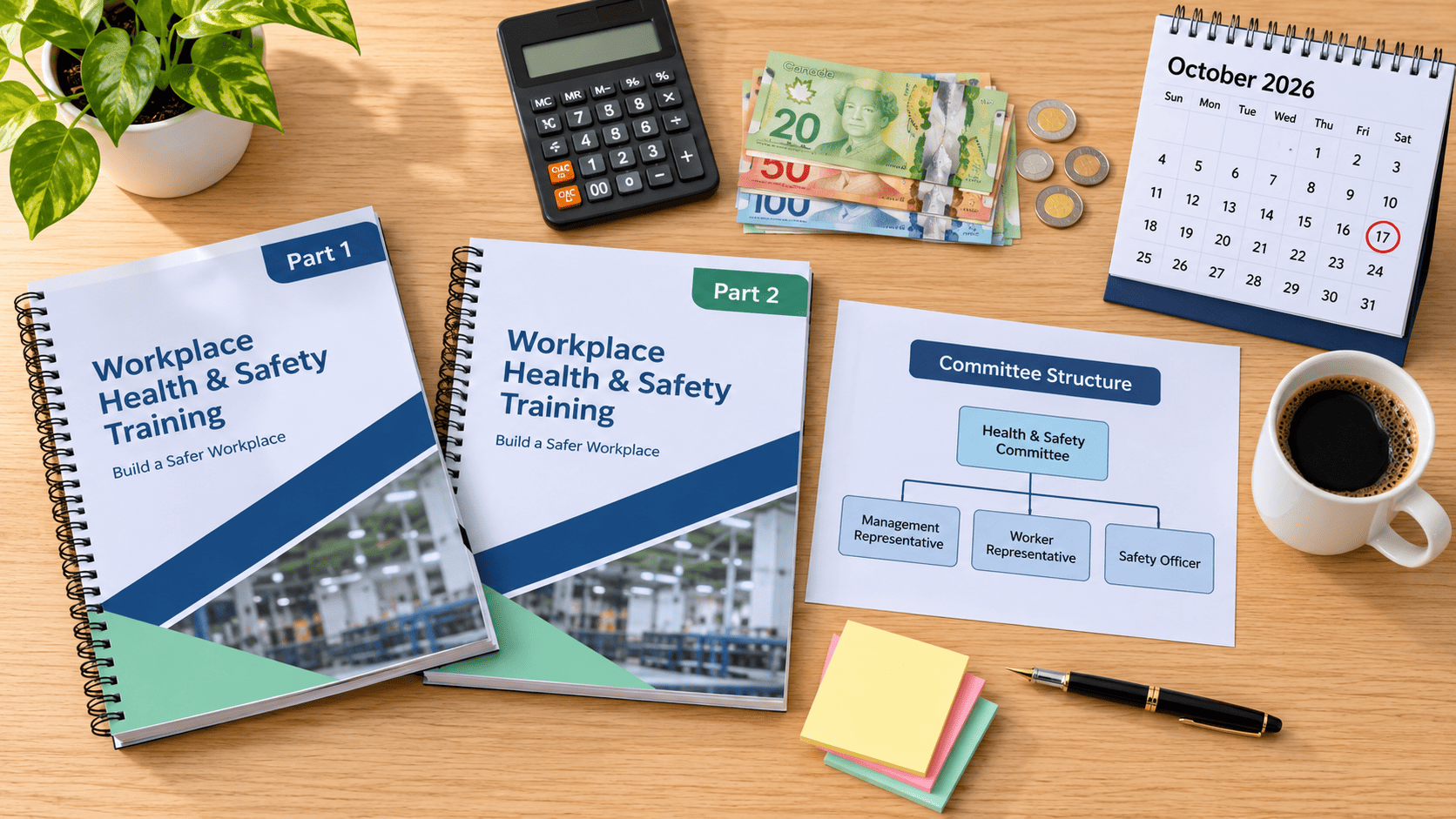

Quick answer: Yes. Under section 9 of Ontario’s Occupational Health and Safety Act (OHSA), most workplaces with 20 or more workers regularly employed must have a Joint Health and Safety Committee (JHSC), and at least one worker member and one management member of that committee must be certified. Workplaces with 6 to 19 workers need a Health and Safety Representative instead.
“Do we actually have to get our committee members certified, or is it just recommended?” It is one of the most common questions Ontario employers ask, especially as a business grows past 20 workers. The short answer is that JHSC certification is a legal requirement, not a best practice, for most mid-sized and larger workplaces.
This guide explains exactly when JHSC certification is mandatory, who must be certified, what changes by workplace size, and what employers need to do to stay compliant. If you’re new to the topic, start with what JHSC certification is.
Key takeaways
- Is it mandatory? Yes, wherever a JHSC is required by law.
- Legal basis: OHSA section 9, with the certified member rule in section 9(12).
- Threshold: generally 20 or more workers regularly employed, including part-time.
- Who must be certified: at least one worker member and one management member.
- How: CPO approved Part 1 and Part 2 training, with Part 2 completed within 12 months of Part 1.
- Staying compliant: refresher training every three years.
Is JHSC certification mandatory in Ontario?
Yes. JHSC certification is mandatory in every Ontario workplace that is legally required to have a JHSC. The law doesn’t require every committee member to be certified, but it does require a minimum of two certified members: one representing workers and one representing management.
If your workplace needs a JHSC and doesn’t have certified members, it is not in compliance with the OHSA.
What law requires JHSC certification?
The requirement comes from section 9 of Ontario’s Occupational Health and Safety Act (OHSA):
- Section 9 sets out when a joint health and safety committee must be established and how it is made up.
- Section 9(12) requires the employer and the workers to make sure that at least one management member and one worker member of the committee are certified members.
- Certification standards are set by Ontario’s Chief Prevention Officer (CPO), and training must be delivered by a CPO approved provider.
The OHSA is enforced by the Ministry of Labour, Immigration, Training and Skills Development (often still called the Ministry of Labour).
JHSC requirements by workplace size
What the law requires depends mainly on how many workers are regularly employed at the workplace. This includes full-time and part-time workers who work there on a regular basis.
| Workers regularly employed | JHSC required? | Minimum committee size | Certified members required? |
|---|---|---|---|
| 1 to 5 | Generally no | — | No (unless designated substance rules apply) |
| 6 to 19 | No | Health and Safety Representative instead | No (a representative is not a certified member) |
| 20 to 49 | Yes | At least 2 members | Yes: at least 1 worker + 1 management |
| 50 or more | Yes | At least 4 members | Yes: at least 1 worker + 1 management |
For the full breakdown, see our guide to Ontario JHSC legal requirements.
When smaller workplaces still need a JHSC
A JHSC can be required in workplaces with fewer than 20 workers when a regulation for a designated substance (such as asbestos, lead or silica) applies. The Minister of Labour can also order a JHSC to be set up in a specific workplace.
How the rules apply to construction projects
On construction projects, a JHSC is required where 20 or more workers are regularly employed and the project is expected to last three months or more. Smaller projects with 6 or more workers need a Health and Safety Representative.
Who must have JHSC certification?
Where a JHSC is required, the law requires at least:
| Role | Who selects them | Certification required? |
|---|---|---|
| Worker member | Selected by workers, or by the union where one exists | At least one must be certified |
| Management member | Selected by the employer from people who exercise managerial functions | At least one must be certified |
If a certified member leaves or can’t act, the employer and workers must make sure a replacement becomes certified. Many employers certify more than the minimum to cover multiple shifts, sites, vacations and turnover.
What are an employer’s JHSC obligations?
Once a JHSC is required, employers must:
- Set up the committee with the right number of members, at least half of them worker members.
- Make sure the minimum certified members are in place: one worker and one management.
- Pay for certification training and treat time spent in training as work time, paid at the regular or premium rate that applies.
- Support committee activities: regular meetings, monthly workplace inspections and access to information.
- Respond to written JHSC recommendations within 21 days.
- Post the names and work locations of committee members where workers can see them.
- Keep certification current through refresher training every three years. See JHSC certification expiry and renewal.
What happens if you don’t comply?
Ministry inspectors check JHSC compliance during workplace inspections. If a required JHSC or its certified members are missing, an inspector can issue an order to comply with a deadline to fix it.
Continued non-compliance can lead to prosecution under the OHSA, with significant fines for corporations and for individual directors and officers. Missing certified members can also weaken your due diligence defence if a serious incident occurs.
How do you become compliant?
To meet the certification requirement:
- Choose the worker and management members to be certified.
- Enrol them in CPO approved JHSC Part 1 (available as self-paced e-learning, virtual or in person).
- Complete JHSC Part 2 within 12 months of Part 1. A JHSC Part 1 and Part 2 bundle keeps both on schedule.
- Once both parts are complete, they become certified members.
- Schedule refresher training before each three-year expiry.
Frequently asked questions
Is JHSC certification mandatory in Ontario?
Yes, in any workplace where a JHSC is legally required, which is generally workplaces with 20 or more workers regularly employed. At least one worker member and one management member must be certified.
Who must have JHSC certification?
At least one worker representative and one management representative on the JHSC. Other committee members don’t have to be certified, but many employers certify more for coverage.
Do part-time workers count toward the 20-worker threshold?
Yes. The threshold counts workers regularly employed at the workplace, which includes part-time workers who work there regularly.
Does a Health and Safety Representative need JHSC certification?
No. Workplaces with 6 to 19 workers need a Health and Safety Representative, who is not required to be a certified JHSC member, though training is recommended.
Who pays for JHSC certification training?
The employer. Time spent in certification training is treated as work time and paid at the applicable rate.
What happens if my workplace doesn’t have certified JHSC members?
A Ministry inspector can issue an order to comply. Continued non-compliance can lead to prosecution and fines under the OHSA.
Does JHSC certification expire?
Yes. Certified members must complete refresher training every three years to stay certified.
Conclusion
JHSC certification is not optional for most Ontario employers. If your workplace regularly employs 20 or more workers, OHSA section 9 requires a JHSC with at least one certified worker member and one certified management member, and that certification must be kept current every three years.
The good news is that becoming compliant is straightforward: choose your members, complete CPO approved Part 1 and Part 2 training, and plan refreshers ahead of time. To check exactly who must have JHSC certification in your workplace, see our full requirements guide.
Ready to meet the requirement? Get your team JHSC certified with 4S Consulting’s CPO approved JHSC certification training, available as self-paced e-learning, live virtual or in-person sessions.
About the author
Sobi Ragunathan is Vice President of Operations, Strategy & Partnerships at 4S Consulting Services Inc. Sobi supports Ontario employers with workplace health and safety, COR®, ISO 45001, WSIB Health and Safety Excellence program implementation, and JHSC certification training.
This article provides general information about Ontario’s OHSA and is not legal advice.