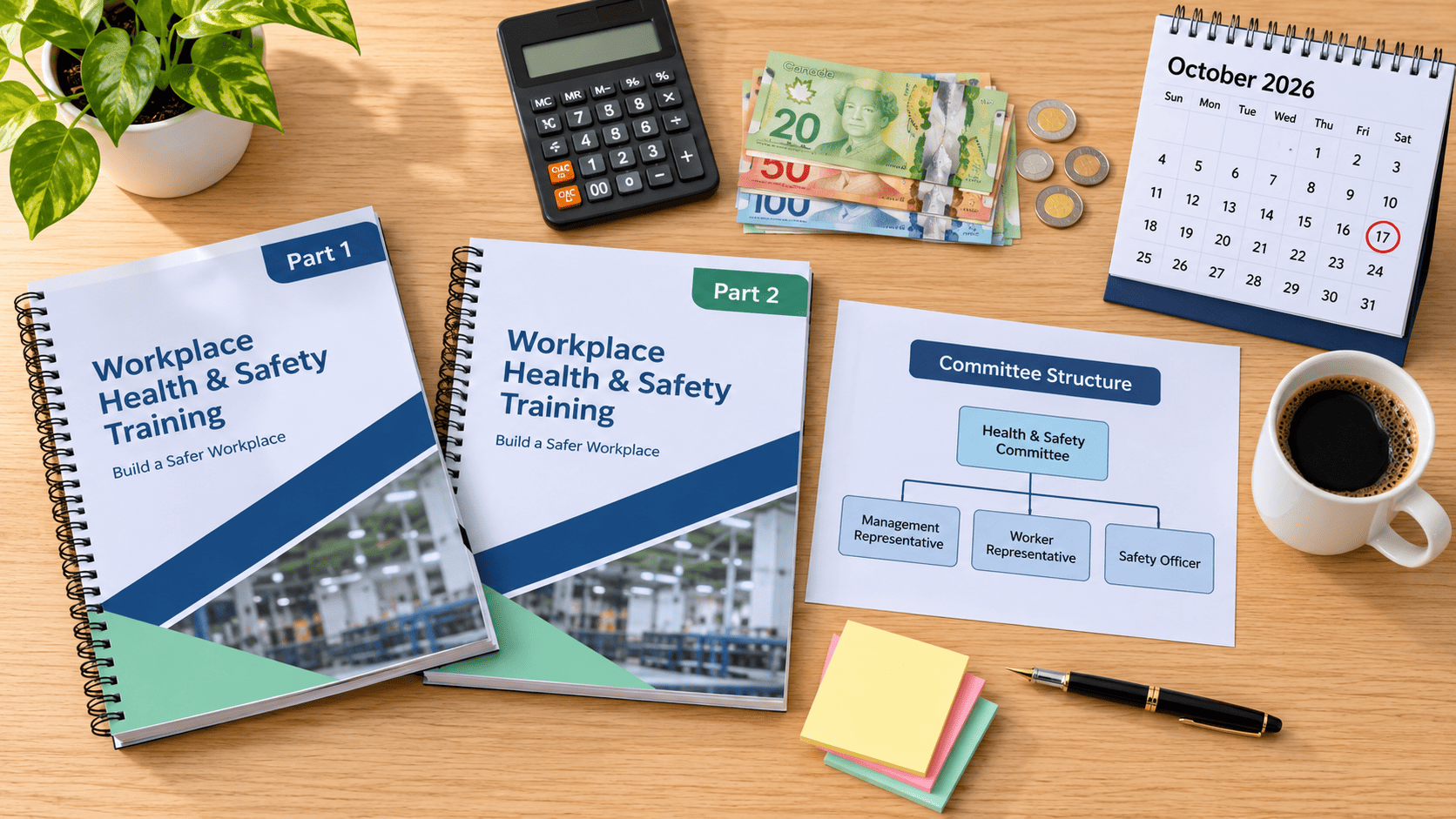

Quick answer: JHSC stands for Joint Health and Safety Committee. JHSC certification is the training an Ontario committee member completes to become a “certified member”: CPO approved Part 1 and Part 2 training. Workplaces that need a JHSC must have at least one certified worker member and one certified management member.
If you have just joined a health and safety committee, or your company has grown past 20 workers, you have probably heard the term “JHSC certification” and wondered what it actually means. This guide explains what a JHSC is, why Ontario law requires one, who sits on it, and what it takes to become a certified member.
Key takeaways
- JHSC full form: Joint Health and Safety Committee.
- What it is: a workplace committee of worker and management representatives who work together to identify hazards and recommend improvements.
- Legal basis: section 9 of Ontario’s Occupational Health and Safety Act (OHSA).
- When it’s required: generally in workplaces with 20 or more workers regularly employed.
- Certification: CPO approved Part 1 and Part 2 training, with refresher training every three years.
What does JHSC stand for?
JHSC stands for Joint Health and Safety Committee. “Joint” means the committee is shared between the two workplace parties: workers and management. You may also see it written as “Joint Health & Safety Committee” or shortened to “the joint committee.”
What is a JHSC?
A JHSC is a workplace committee made up of worker and employer representatives who work together to identify hazards, make recommendations, conduct inspections and support workplace safety initiatives. It gives workers a formal voice in health and safety, alongside management.
The JHSC is a key part of Ontario’s Internal Responsibility System (IRS), the principle that everyone in the workplace shares responsibility for health and safety. The committee is not responsible for safety on its own. Instead, it acts as an advisory body that helps the employer find and fix problems before people get hurt.
What is the legal basis for a JHSC in Ontario?
Joint health and safety committees are required under section 9 of Ontario’s Occupational Health and Safety Act (OHSA). In general:
| Workers regularly employed (includes part-time) | What the law requires |
|---|---|
| 1 to 5 | A JHSC is generally not required (other rules may apply if designated substances are present) |
| 6 to 19 | A Health and Safety Representative selected by workers |
| 20 to 49 | A JHSC with at least two members |
| 50 or more | A JHSC with at least four members |
For a full breakdown of who needs a committee and who must be certified, see our guide to JHSC certification requirements in Ontario.
Who sits on a JHSC?
A JHSC has two types of members:
- Worker representatives: selected by the workers they represent, or by their union where one exists. At least half of the committee must be worker members.
- Management representatives: chosen by the employer from people who exercise managerial functions at the workplace.
The committee has two co-chairs, one chosen by the worker members and one by the management members. JHSCs typically meet at least every three months, and more often in higher-risk workplaces.
What is JHSC certification?
JHSC certification is the training a committee member completes to become a certified member under Ontario law. Certified members have extra knowledge and specific legal powers that other committee members don’t.
Where a JHSC is required, at least one worker member and one management member must be certified. Many employers certify more members to cover shifts, vacations and turnover.
Certification training must be delivered by a provider approved by Ontario’s Chief Prevention Officer (CPO). Training from a provider without CPO approval does not count toward certification.
How do you get JHSC certified?
JHSC certification follows four steps:
- Complete JHSC Part 1. Part 1 covers the OHSA, rights and responsibilities, the IRS, hazard recognition, workplace inspections, incident investigations and JHSC duties. It’s available as self-paced e-learning (about 13 hours), virtual instructor-led or in-person training.
- Complete JHSC Part 2 within 12 months. Part 2 focuses on hazards and controls specific to your workplace and industry.
- Become a certified member. Once both parts are complete, the participant is a certified JHSC member.
- Complete refresher training every three years to keep certification active.
Why is JHSC important?
A well-run JHSC helps an organization:
- Prevent injuries and illnesses by spotting hazards before incidents happen
- Meet legal requirements under the OHSA and show due diligence
- Engage workers by giving them a direct channel to raise concerns
- Pass audits and inspections, including Ministry inspections, COR® and ISO 45001
- Build a stronger safety culture where safety is shared, not just enforced
What do JHSC members and certified members do?
JHSC members share responsibilities that keep the committee effective. Certified members are often the ones designated for these roles because of their training:
- Workplace inspections: a designated worker member inspects the workplace at least once a month, or a part of it each month so the whole workplace is covered over the year.
- Work refusals: a worker member is present during the investigation of a worker’s refusal to do unsafe work.
- Incident investigations: a designated worker member investigates critical injuries and fatalities.
- Written recommendations: the committee makes recommendations to the employer, who must respond in writing within 21 days.
Certified members also hold a power other members don’t: they can direct that work be stopped when certain dangerous circumstances exist.
Frequently asked questions
What does JHSC stand for?
JHSC stands for Joint Health and Safety Committee, a workplace committee of worker and management representatives required under Ontario’s Occupational Health and Safety Act.
What is JHSC certification in Ontario?
JHSC certification is CPO approved Part 1 and Part 2 training that makes a committee member a “certified member” under the OHSA. It must be maintained with refresher training every three years.
Is JHSC certification mandatory?
Yes, where a JHSC is required. At least one worker member and one management member must be certified. Other committee members don’t have to be certified, though many employers certify more.
How long does JHSC certification take?
Part 1 takes about 13 hours by self-paced e-learning, or longer in a classroom. Part 2 must be completed within 12 months of Part 1.
What is the difference between a JHSC and a Health and Safety Representative?
A JHSC is a committee required in workplaces with 20 or more workers. A Health and Safety Representative is a single worker selected by workers in workplaces with 6 to 19 workers.
Can JHSC Part 1 be done online?
Yes. CPO approved providers offer self-paced e-learning for Part 1 that meets certification requirements.
Conclusion
A JHSC (Joint Health and Safety Committee) brings workers and management together to make Ontario workplaces safer. JHSC certification gives committee members the training and legal standing to lead inspections, investigations and recommendations, and every required committee needs at least one certified worker member and one certified management member.
Whether you have just joined a committee or need to meet the requirement for your workplace, the next step is CPO approved JHSC certification training.
Ready to take the next step? Get JHSC certified with 4S Consulting’s CPO approved Part 1, Part 2 and Refresher training, available online, virtually or in person.
About the author
Sobi Ragunathan is Vice President of Operations, Strategy & Partnerships at 4S Consulting Services Inc. Sobi supports Ontario employers with workplace health and safety, COR®, ISO 45001, WSIB Health and Safety Excellence program implementation, and JHSC certification training.