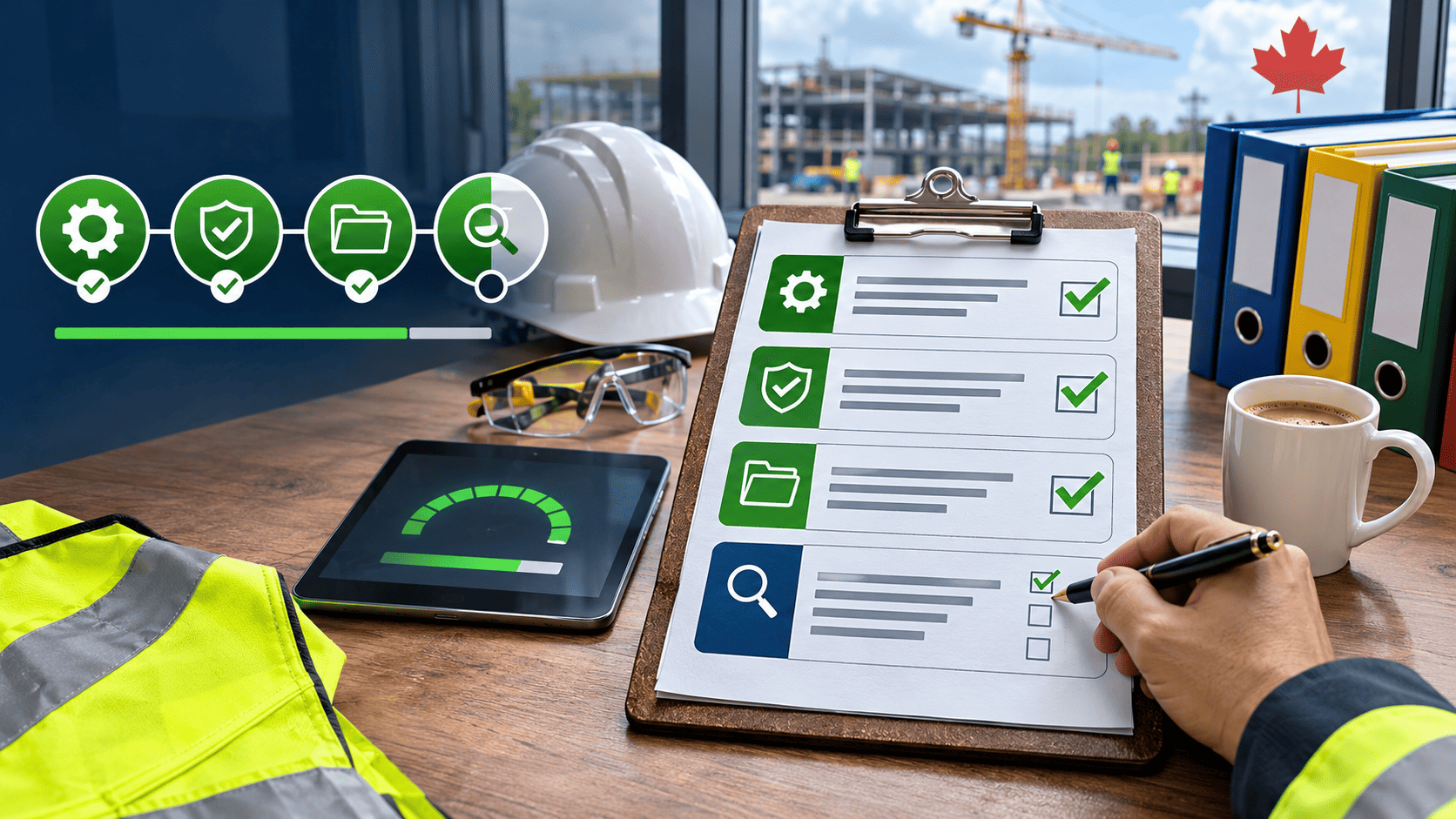

Quick answer: COR® (Certificate of Recognition) is a Canadian occupational health and safety certification. It confirms that an employer’s health and safety management system is documented, implemented and verified by an external audit. The national standard is overseen by the Canadian Federation of Construction Safety Associations (CFCSA), and each province’s safety association issues the certificate.
Many owners, general contractors and public agencies require COR before a company can bid or get on site. That makes COR as much a growth tool as a safety program: it opens larger contracts, meets tender requirements, reduces liability and builds client trust.
This guide covers the COR basics: what a COR certificate is, who issues it, how the audit works, how long it takes and how to pass the first time.
At 4S, we help Canadian businesses achieve COR certification faster through hands-on implementation, audit preparation and our digital compliance platform, 4SafeCom™.
Who Issues COR Certification in Canada?
COR follows one national standard, but there is no single national certificate. Each province has its own OHS legislation, so each has its own COR organization that grants certification and can add jurisdiction-specific requirements.
| Province | Certifying body |
|---|---|
| Ontario | Infrastructure Health & Safety Association (IHSA) |
| Alberta | Alberta Construction Safety Association (ACSA) |
| British Columbia | BC Construction Safety Alliance (BCCSA) |
| Saskatchewan | Saskatchewan Construction Safety Association (SCSA) |
| Manitoba | Construction Safety Association of Manitoba (CSAM) |
| Nova Scotia | Construction Safety Nova Scotia (CSNS) |
These bodies set audit standards, approve certifications, qualify auditors and manage annual maintenance requirements.
Working in More Than One Province? COR Reciprocity
COR earned in one province does not carry over automatically. The CFCSA states that COR must be granted by the authority in each province or territory where you work. Instead of starting from scratch, you can usually apply for reciprocity (equivalency):
- Provide proof of your existing COR
- Submit your audit documentation
- Meet any province-specific requirements
- Register with the local authority
Example: An Alberta contractor holding COR through ACSA wants to bid in Ontario, Saskatchewan and BC. It would seek recognition through IHSA, SCSA and BCCSA. In Ontario, IHSA is the only body that can grant COR, and owners such as Metrolinx, Infrastructure Ontario and the City of Toronto increasingly require it for bid eligibility.
What Is a COR Certificate?
A COR certificate is official proof that a company’s Occupational Health and Safety Management System (OHSMS) meets the COR standard and has passed an external audit. It shows that:
- Safety policies and procedures are documented
- Those procedures are actually used on site
- Workers and supervisors are trained and engaged
- Hazards are identified and controlled
The OHSMS behind the certificate typically includes a safety policy, hazard assessments, safe work procedures, training, inspections, incident investigations, emergency response planning and continuous improvement.
Why COR Certification Matters
- Contract eligibility: Many public infrastructure projects and general contractors require COR to bid or access a site.
- Fewer incidents: Better hazard management and reporting mean fewer injuries, less downtime and lower compensation claims.
- Reduced liability: A documented, working system lowers legal and financial risk after an incident.
- Financial incentives: Some provinces and workers’ compensation boards offer rebates for recognized safety systems.
- Client trust: Clients see COR as proof of professional risk management, giving you a competitive edge.
Who Needs COR Certification?
COR is most common in construction, but any high-risk industry benefits from it.
| Industry | Why COR matters |
|---|---|
| Construction | Tender eligibility; general contractors often require subcontractors to hold COR before site access |
| Infrastructure and civil (roads, utilities, excavation, public works) | Frequently required for municipal and provincial projects |
| Manufacturing | Machine safety, hazard control and meeting client and insurer expectations |
| Oil and gas | Field procedures, contractor management and emergency response |
| Transportation and logistics | Driver safety, fleet compliance and lower liability |
| Industrial services | Equipment procedures, contractor compliance and site access approvals |
How to Get COR Certification: 7 Steps
- Gap analysis: Review your policies, documents, training records and practices against COR requirements to build a roadmap.
- Safety program development: Build or improve your OHSMS: safety manual, hazard assessments, safe work procedures, orientation, emergency plans and inspection system.
- Training: Train workers, supervisors and managers on orientation, hazard awareness, incident reporting, equipment safety and leadership responsibilities. See COR certification training for the required courses.
- Implementation: Use the system every day through inspections, toolbox talks, hazard assessments and record-keeping. Documentation alone will not pass.
- Internal audit: Evaluate your readiness and close gaps before the official audit.
- External audit: A certified COR auditor reviews documents, interviews workers and supervisors, observes worksites and verifies records.
- Certification: If you meet the scoring requirements, your provincial certifying body issues your COR. For the full process, see how to get COR certification.
COR Audit Requirements
A COR audit tests one thing: is what you have documented actually implemented? Auditors review policies and procedures, safety documentation, training records, hazard assessments and incident investigations. They also interview workers and supervisors and observe active sites.
Minimum Passing Scores
- 80% minimum overall score
- 50% minimum in every element (65% in Ontario)
Failing a single element can block certification.
Core COR Elements
Element names and numbers vary by province, but most COR programs cover:
- Management leadership and commitment
- Hazard assessment and control
- Safe work practices and procedures
- Worker orientation
- Training and competency
- Workplace inspections
- Incident investigation
- Emergency preparedness
- Health and safety communication
- Contractor management
- Statistics, records and document control
- Program evaluation and continuous improvement
How Long Does COR Certification Take?
Most companies achieve COR in about 12 months. The timeline depends on company size, existing safety systems, workforce complexity, documentation readiness, internal resources, leadership involvement and access to active sites during the audit.
Seasonal work is the most common hidden delay. Auditors must see representative work, meaning your core business in action. An excavation or road-building company cannot show that when the ground is frozen, so its audit may slip to the next season.
Why Companies Fail COR Audits
Most failures come from paperwork without implementation:
- Incomplete documentation and poor document control
- Missing training, inspection or incident records
- Weak or missing hazard assessments
- Inconsistent inspections and low worker participation
- Supervisors who cannot explain the safety system or their role in it
- No active sites that show the core business
- Records created for the audit instead of kept all year
How to Pass a COR Audit
- Build a structured OHSMS: Policies, procedures, hazard assessments and documented inspections with follow-up and corrective actions.
- Train workers and supervisors: Auditors interview them directly on hazards, procedures, reporting and emergency response.
- Keep records current all year: Inspections, toolbox talks, orientations, training certificates, incident reports and meeting minutes.
- Run mock audits: They expose gaps in implementation, consistency and employee understanding, and build confidence from workers up to senior management.
- Use a digital compliance system: 4SafeCom™ keeps documentation, training, inspections, incidents and audit evidence in one place, so your program does not depend on one person.
- Work with an experienced COR consultant: Get expert guidance on implementation, audit preparation and corrective actions.
COR vs SECOR vs ISO 45001
| COR | SECOR | ISO 45001 | |
|---|---|---|---|
| What it is | Canadian certification, administered by each province | Small Employer Certificate of Recognition | International OHS management standard |
| Best for | Mid-size and larger employers | Small employers with fewer workers | Organizations of any size, often large corporations |
| Where available | Across Canada; requirements differ by province | Alberta, BC, Saskatchewan and Manitoba only | Worldwide |
| Approach | Prescriptive audit against the provincial COR standard | Simplified requirements and audit | Management system certification |
| Common in | Construction and government projects | Small contractors | Many industries |
Some companies hold both COR and ISO 45001. Compared with a basic safety program that only meets minimum legal requirements, COR adds formal recognition, structured auditing, industry credibility and tender eligibility.
Why Work with a COR Consultant?
COR is detailed, and companies without established processes often find it hard to implement. A consultant brings that expertise in when you need it. At 4S, we also train your team to run the system with minimal outside help once it is in place.
Why Businesses Choose 4S
4S has guided hundreds of organizations through COR certification. We provide:
- Gap analysis and a clear certification roadmap
- Hands-on implementation, not just documentation
- Training and coaching so your people own the program
- Audit preparation: mock audits, documentation review and corrective action planning
- 4SafeCom™, our digital platform for safety documentation, training records, e-learning, inspections, preventative maintenance, scheduling, audit evidence and compliance workflows, implemented as part of every engagement
- Ongoing support to maintain COR after certification
The result: faster certification, fewer audit errors and minimal disruption to your operations.
Frequently Asked Questions
What is COR certification?
COR (Certificate of Recognition) is a Canadian health and safety certification. It verifies, through an external audit, that an employer has an effective and implemented safety management system.
What does COR stand for?
COR stands for Certificate of Recognition. Learn more about the COR certificate meaning.
Is COR certification required by law?
No. COR is not a legal requirement for every business. However, many government projects, owners and general contractors require it to bid or work on site.
How long does it take to get COR certified?
Most companies take about 12 months. Seasonal businesses may wait longer if active sites are not available during the audit.
How much does COR certification cost?
Cost depends on company size, industry, existing safety systems, audit requirements and the level of consulting support. Typical costs cover training, implementation, audits and consulting. See our guide to COR certification cost in Canada.
How long does COR certification last?
COR stays active through annual maintenance audits and periodic recertification audits.
Is COR valid in every province?
No. COR is granted province by province. If you already hold COR, you can usually apply for reciprocity in another province instead of starting over.
How do I prepare for a COR audit?
Review your documentation, keep inspections and records current, train workers and supervisors, run a mock audit and correct any gaps it finds.
What is the difference between COR and SECOR?
COR is for larger or more complex employers. SECOR is a simplified program for small employers, available only in Alberta, BC, Saskatchewan and Manitoba.
Can small businesses get COR certified?
Yes. Small businesses can pursue COR, or SECOR where it is available.
Conclusion
COR certification proves your safety system works, on paper and on site. For many Canadian companies it is no longer optional: it opens contracts, reduces incidents and builds client trust. Getting there takes real implementation, consistent records, trained people and thorough audit preparation, which is why many businesses work with an experienced COR consultant.
Talk to a COR Consultant. 4S helps you build an audit-ready safety system and achieve COR certification faster.