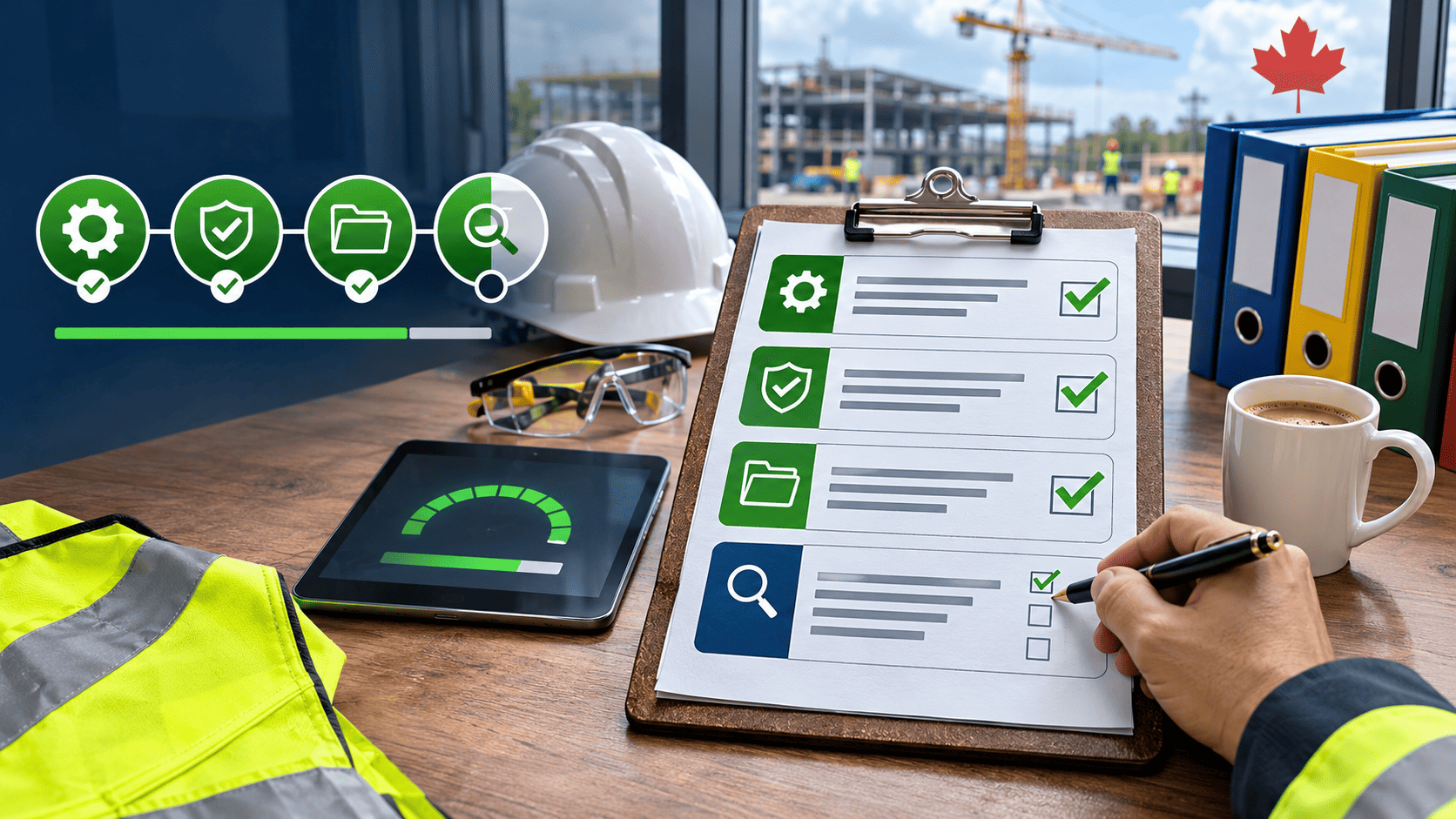

What is COR certification training? It has two parts:
- Mandatory COR program courses: your provincial certifying body requires these before you can be certified. In Ontario, IHSA requires one course for a senior management representative and four courses for a full-time employee who becomes your internal auditor. In Alberta, ACSA requires courses including Principles of Health and Safety Management (PHSM), Leadership for Safety Excellence (LSE) and the Auditor Training Program (ATP).
- Workforce safety training: orientation, hazard awareness, WHMIS, equipment and supervisor training. COR auditors check that your workers have this training and understand it.
COR certification belongs to the company, not the individual. Training is how your people earn it. This guide covers both parts, plus the records auditors expect. New to COR? Start with what COR certification is.
COR training in Ontario: IHSA requires one course for your senior management representative, and four courses, including COR® Essentials, for a permanent full-time employee who becomes your internal auditor. Only IHSA’s courses count toward COR in Ontario, so book them early. Read What Is COR Certification in Ontario? or talk to our COR consultants in Ontario.
Mandatory COR Courses by Province
Every certifying body sets its own required COR training. Most follow a similar pattern: one or more courses for senior management, and a set of courses (often four) for the person who will run your internal audits.
The 4 National COR® Training Competencies
The CFCSA’s National COR® Accreditation Standard requires one or more of your employees to complete four training competencies:
- Health and Safety Program Development and Implementation
- Leadership, Training and Communication
- Safety Auditor Training
- Hazard Identification and Risk Control
These do not have to be four separate courses. Each certifying body delivers them through its own course structure, which is why course names and counts differ by province. Training is the first step of the CFCSA’s three-step roadmap to COR®, followed by implementation and verification.
| Province (certifying body) | Who must train | Required COR courses |
|---|---|---|
| Ontario (IHSA) | One senior management representative, and one permanent full-time employee who becomes the internal auditor | Senior management: one course. Internal auditor: four IHSA courses, including COR® Essentials (IHSA) |
| Alberta (ACSA) | At least one full-time employee; the courses can be split across several employees | Principles of Health & Safety Management (PHSM), Leadership for Safety Excellence (LSE) and the Auditor Training Program (ATP), plus a self-qualification audit to become a certified auditor (ACSA) |
| Manitoba (CSAM) | Company representatives | Principles of Safety Management, Leadership for Safety Excellence, Safety Auditor and Train the Trainer (CSAM) |
| Other provinces | Varies | Check with your certifying body |
A few details matter:
- Order: in Alberta, PHSM must be completed before the Auditor Training Program.
- Two levels: ACSA’s LSE and ATP each have a course certificate and a second, proficiency or certified-auditor level that requires submitting real documents or an audit.
- Pass marks: most of these courses require at least 80% on the final test.
- SECOR: small employers in Alberta take a shorter path (PHSM for SECOR). See COR vs SECOR.
Only your certifying body’s courses count toward COR. A consultant can prepare your team, but cannot replace these required courses.
COR training in Ontario: IHSA requires one course for your senior management representative and four courses, including COR® Essentials, for a permanent full-time employee who becomes your internal auditor. All courses are taken through IHSA, and only IHSA training counts toward COR in Ontario. Book them early, because they come before your internal audit.
COR Training vs COR Certification
| Individuals | The organization | |
|---|---|---|
| What they earn | Course certificates (e.g., COR® Essentials, PHSM) and, for auditors, certified auditor status | The Certificate of Recognition |
| How | Complete courses and pass tests | Implement a safety system and pass the COR audit |
| What it proves | Personal knowledge and competency | A working, audited safety management system |
Employees do not become “COR certified”. The company does. Your trained people are what make the company’s certification possible.
Workforce Safety Training COR Auditors Expect
Beyond the mandatory COR courses, auditors check that everyone has training matched to their role and hazards. What you need depends on your industry, province, equipment and hazard assessments.
| Role | Typical training |
|---|---|
| All workers | Orientation (policies, hazard reporting, emergency procedures, PPE), hazard awareness, WHMIS, safe work procedures, incident reporting |
| Equipment operators | Equipment-specific training with competency checks (forklifts, aerial lifts, cranes, power tools, commercial vehicles) |
| Workers exposed to specific hazards | Working at heights and fall protection, lockout/tagout, confined space, respiratory protection, as your hazard assessments require |
| Supervisors | Supervisor health and safety awareness, hazard recognition, workplace inspections, incident investigation, leadership and legal duties |
| Managers | Safety system oversight, resource allocation, policy and performance review |
| Health and safety representatives and committee members | Inspections, incident review and committee training (certification where your province requires it) |
| Contractors | Site orientation, site-specific hazards, permits and emergency procedures |
Supervisors deserve extra attention. Auditors interview them closely, and supervisor competency is one of the strongest signals of a working system. For construction-specific courses, see COR certification for construction companies.
How COR Auditors Verify Training
Having certificates is not enough. Auditors check three things:
- Records: certificates, sign-in sheets (date, topic, trainer, signatures), orientation forms, competency evaluations and refresher logs
- Competency: practical evaluations, observation checklists and supervisor sign-offs showing people can do the task safely
- Interviews: workers are asked questions such as “How do you report a hazard?”, “What do you do after an incident?” and “What are the emergency procedures here?” If they cannot answer, the training has not worked.
Use a Training Matrix
A training matrix is the single most useful audit tool. It shows who needs what training, when they completed it and when it expires:
| Employee | Position | Required training | Completed | Expires |
|---|---|---|---|---|
| J. Doe | Supervisor | WHMIS | Jan 2026 | Jan 2027 |
| J. Smith | Operator | Forklift | Feb 2026 | Feb 2029 |
It makes gaps and upcoming expiries visible, and lets you answer an auditor’s questions in seconds.
Building a COR-Ready Training Program
- Book the mandatory COR courses early. Course dates and prerequisites, such as PHSM before ATP, can add weeks to your timeline.
- Run a training needs assessment based on your hazard assessments, legal requirements and job roles.
- Build a training matrix for every employee.
- Verify competency, not just attendance.
- Schedule refreshers for WHMIS, emergency drills, equipment and supervisor training.
- Review effectiveness using completion rates, incident trends, audit findings and employee feedback.
Common Training Mistakes That Hurt COR Audits
| Mistake | Fix |
|---|---|
| Missing certificates and sign-in sheets | Centralize all records in one system |
| Outdated training | Set refresher schedules and review requirements yearly |
| Attendance without competency checks | Add practical evaluations and sign-offs |
| Different record formats across departments | Standardize forms and filing |
| Disengaged supervisors | Give supervisors leadership training and hold them accountable |
| Mandatory COR courses booked too late | Plan them into your COR timeline from day one |
Online training is acceptable when the content is relevant, completion is documented and competency is verified in practice.
COR Training Checklist Before Your Audit
- Mandatory COR courses completed by the required people, with certificates on file
- Internal auditor certified, including any qualification audit
- Orientation completed and signed for every worker
- WHMIS, hazard awareness, emergency response and incident reporting training current
- Equipment training documented with competency evaluations
- Supervisor training completed (awareness, inspections, investigations)
- Training matrix up to date, with expiries flagged
- Certificates, sign-in sheets and evaluations stored centrally and easy to find
- Refresher schedule documented
- Workers and supervisors can explain hazard reporting, incident reporting and emergency procedures
For a full audit checklist, see COR certification checklist.
How 4S Supports COR Training
Training records are much easier to manage digitally. 4SafeCom™ tracks completions, manages your training matrix, sends expiry reminders, and lets you pull any record in seconds during an audit. It also includes e-learning for company-specific training.
Our COR certification consultants help you:
- Plan the mandatory COR courses for your province, and fit them into your timeline
- Assess training gaps against your hazards, legal duties and roles
- Build training frameworks, matrices and competency checks
- Coach supervisors for audit interviews
- Prepare for the audit with documentation reviews and mock audits
Why Ontario employers choose 4S for COR®: 10+ years of COR consulting · 120+ of the 900+ COR-certified employers on IHSA’s list supported by 4S · 100% external audit success, with an average COR audit score above 90% · 10 of Ontario’s 118 SOSE-accredited employers supported by 4S. Figures as of October 2026.
Not sure your training would pass a COR audit? Request a training gap assessment.
Frequently Asked Questions
Is there a COR certification course?
Yes. Each provincial certifying body has mandatory COR courses, such as IHSA’s COR® Essentials in Ontario and ACSA’s PHSM, LSE and Auditor Training Program in Alberta. Completing them does not certify a person, but your company cannot get COR without them.
What are the 4 courses for COR certification?
Nationally, the CFCSA standard requires four training competencies: program development and implementation; leadership, training and communication; safety auditor training; and hazard identification and risk control. Each province delivers them through its own courses. In Ontario, IHSA requires a permanent full-time employee to complete four courses to become the internal auditor. In Manitoba, CSAM has listed Principles of Safety Management, Leadership for Safety Excellence, Safety Auditor and Train the Trainer. In Alberta, ACSA’s required courses include PHSM, LSE and ATP.
Can an employee be COR certified?
No. Only organizations are COR certified. Individuals earn course certificates and can become certified COR auditors.
Who needs to take COR training?
At minimum, a senior management representative and the person who will be your internal auditor. All workers also need role-specific safety training that auditors will check.
What construction safety courses support COR?
Common ones include WHMIS, working at heights and fall protection, confined space, supervisor health and safety awareness, incident investigation and equipment-specific training, based on your hazards.
How do COR auditors check training?
Through records, competency evaluations and interviews with workers and supervisors.
Can online training count for COR?
Yes, if the content is relevant, completion is documented and competency is verified. Some certifying body courses are also offered online.
Conclusion
COR certification training means two things: the mandatory COR courses your certifying body requires, and the role-based safety training your whole workforce needs. Get the first done early so it does not delay your audit. Get the second documented and verified so workers can prove what they know. Together, they are the foundation of a successful COR audit.
Ready to strengthen your COR training? Talk to a COR consultant.